Company Background – TD Bank Group
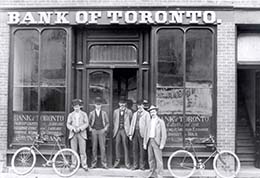
Toronto-Dominion Bank, or TD Bank Group for short, stands as a top-tier and highly impactful financial institution in the North American territory. Based in Toronto, Ontario, TD has changed its face from a local Canadian bank to a giant where retail banking, commercial banking, wealth management, insurance, and wholesale financial services are among the business areas it operates in. In 2025, the bank is reported to have a customer base of over 27 million worldwide and a workforce of more than 100,000 spread across Canada, the USA, and some international markets.
The roots of TD Bank go back to 1855, when the Bank of Toronto was initially established. In 1955, the two banks (The Dominion Bank and Bank of Toronto) merged to create Toronto-Dominion Bank. This union of the two banks signalled the start of TD's change to a financial institution that offers a full range of services. Not only did TD grow gradually through organic growth, but it also took on major acquisitions such as Canada Trust in 2000 and the purchases of a bunch of U.S. banks like Commerce Bank and Banknorth, with which it set foot in the U.S. market. The present-day TD Bank is split into two brands: TD Canada Trust operates in Canada, while TD Bank, America’s Most Convenient Bank®, operates in the United States.
TD’s business encompasses four major sectors. The foremost and largest one is Canadian Personal and Commercial Banking (CPCB), which offers everyday banking products, credit facilities, and small business services to millions of Canadian residents. The second is the U.S. Retail Banking, which is enriched with over 1100 branches located in the Eastern part of the United States, and it has a customer base of 10 million plus. Third is the Wealth Management and Insurance segment, with the provision of investment advisory services, asset management, and offers a variety of insurance products. Fourth comes the Wholesale Banking sector that concentrates on the capital markets, corporate banking, and investment banking departments serving institutional clients.
TD Bank works towards "enriching the lives of customers, communities, and colleagues" as its mission. Their mission is "to be the better bank." These principles are supported by four core values: think like a customer, act with integrity, execute with purpose, and innovate with intention. From the point of view of TD, customers are the core, ethics must be followed, and creating value for the long term must be at the center of their brand identity. The values of the bank are also a vehicle in its marketing strategy, such as the "Unexpectedly Human" campaign, which aims to portray TD as a banking institution that puts empathy, inclusion, and trust first to its customers.
TD, in a similar vein, has committed to environmental, social, and governance (ESG) objectives over recent years. A billion-dollar pledge to the community by 2030 is among the bank's promises, while in 2024 alone, the bank announced more than $69 billion in activities related to sustainable finance. TD is also spending on digital transformation, security, and financial literacy programs for the pockets of the community that are left behind. These moves are part of a bigger gambit on the part of the bank to integrate the business strategy with the social impact and meet stakeholder expectations.
While the bank operates on a strong mission to the public and on an impressive scale, TD Bank’s recent ethical issues, especially its failure in the area of anti–money laundering (AML), have unveiled several weaknesses in its governance and compliance culture. The gap between the declared values and the conclusions of U.S. regulators concerning TD's internal procedures casts a shadow over whether the latter really mirror the former. The disagreement between brand and behaviour is fundamental to the examination of the ethical predicament in this case study.
TD’s story and the carefully crafted strategy behind its growth have made it the leader among banks in North America. On the other hand, being a leader means that the bank has to be accountable for its actions. As TD deals with the consequences of the AML scandal, the stakeholders will be giving it scrutiny as to whether the bank will be able to come back to its ethical roots. The company’s mission and vision not only map out a route for commendation but also only if they are supported by substantial deeds.
APA References
Comparably. (n.d.). TD Bank Group mission, vision & values. Comparably. Retrieved November 6, 2025, from
DCFModeling. (n.d.). TD mission, vision & core values. DCFModeling. Retrieved November 6, 2025, from
FinanceCharts. (n.d.). TD company profile. FinanceCharts. Retrieved November 6, 2025, from
TD Bank. (n.d.). About us. TD Bank, America’s Most Convenient Bank. Retrieved November 6, 2025, from
TD Bank Group. (n.d.). Who we are. TD Bank Group. Retrieved November 6, 2025, from


Your writing does an excellent job of balancing the bank's scale, 27 million customers, four major sectors, and its stated mission values "to be the better bank" with the challenge of the recent AML compliance issues. That final point on the disagreement between brand and behavior is crucial, it definitely shows that deeds must back up the declared mission for long term trust.
ReplyDeleteI am on the same page with you, that declared values are almost insignificant if they are not followed up by a consistent action. The failure to comply with the AML regulations made it very clear how the brand can cover up the internal governance issues. I wonder if their "Unexpectedly Human" campaign by TD will be able to withstand a detailed examination, or if they will have to figure out a different way of delivering a trust message next time.
DeleteThe stark contrasts between what a company says their morals are and what actions they actually commit is a significant trend that is appearing. A stakeholder in TD must have a lot of things to consider about whether they still want to support the bank or not. I wonder if growing on such a large scale contributed to some of their morals decreasing.
ReplyDeleteGood point, Ian. Rapid expansion is usually a challenge for a company's internal controls, and in the case of TD, it looks like they grew faster than they could maintain ethical standards. I am curious if their move to the U.S. market made their compliance systems more complex, and then they got overwhelmed.
DeleteYour overview of TD Bank's organization and value system was not only clear but also well-researched. As a result, you made a significant connection between its growth and the recent AML scandal. Particularly, I like how you pointed out the inconsistency of TD's "Unexpectedly Human" being a brand and the ethical failures inside the company, it shows how critical it is for a company to govern properly if it wants to be trusted with its image. What is your opinion about it? Was the weakening of ethical oversight a natural consequence of TD's rapid expansion into the U.S. market, or do you think that with a stronger leadership, the bank could have stayed true to its values?
ReplyDeleteIn my opinion, you are correct in pointing out the conflict between TD's brand image and its secret, unethical practices. I believe that the company should not necessarily lose its moral control as a result of its rapid growth. However, this is usually the case, and one can hardly find an exception where the top management takes the expansion and growth of the company without losing sight of good governance. If TD had had stronger ethical leadership and a culture that gave the compliance teams more power instead of marginalizing them, the bank would have been able to grow in a controlled way, and its values would still have been intact. The main problem appears to be that ethics became a reaction to situations rather than being the basis.
DeleteI think you did a great job of showing TD's public image here and how it doesn't really align with what came out in the investigation. The bank serves over 27 million people with 100k employees, so the standard of ethical leadership is very high. The gap between their values and the failure here is significant which makes me wonder if these values were ever truly shaping everyday decisions within TD. Or if there should have been more accountability behind these values?
ReplyDeleteI agree—TD's operations on such a large scale call for ethical leadership of a higher level, which cannot be just a part of branding. When virtues such as honesty and customer focus are advertised to the public, but the internal management chooses a different way, it makes one wonder who is really accountable. Maybe those values were more of a goal to be achieved than actual daily practices.
Delete